
From 22 March to 12 April 2026, the al-Muniya Association of Marrakech for the Revival and Preservation of the Heritage of Morocco held the 14th edition of the Zahria of Marrakech, the moussem of orange blossom water distillation, in partnership with the Ministry of Youth, Culture and Communication, the Council of the Marrakech-Safi Region, the Communal Council of the City of Marrakech, Cadi Ayyad University (Faculty of Letters; Higher School of Technology of Kelaat Sraghna), Mohammed VI Polytechnic University in Benguerir, the Aghbalou Sti Fadma educational complex, the shrine of Sidi Bel Abbes, women’s cooperatives, civil society organisations, the Palm Grove Observatory, and educational and professional institutions working in the cultural and tourism industries, museums, guest riads and hotels, such as Dar Cherifa, Riad 1112 Dar Atay, Medina Heritage, the Storytellers’ Café, Jemaa el-Fna square and Arsat Moulay Abdeslam…
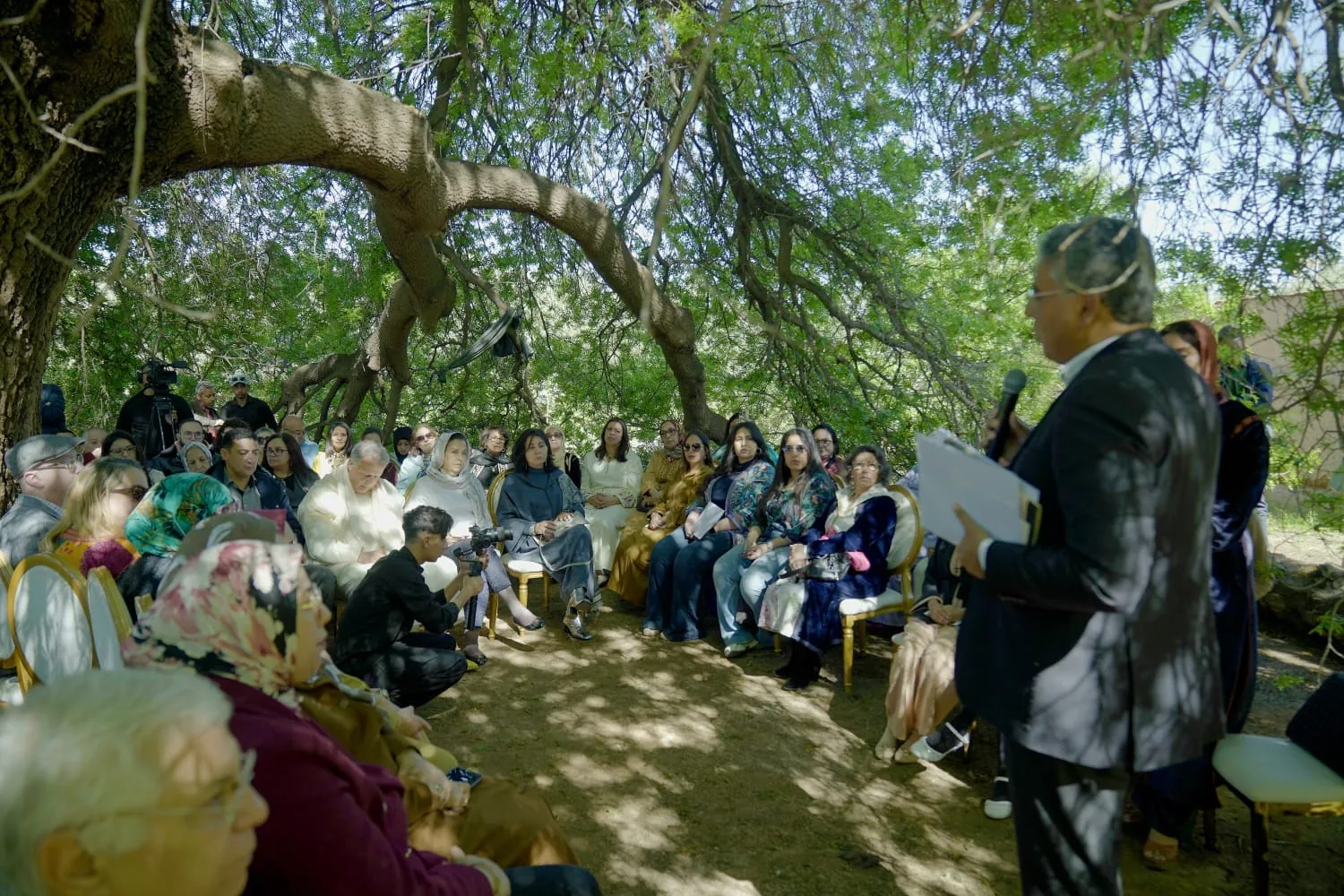
Also worth noting is the colloquium “Morocco’s new heritage protection law: paths to implementation and the roles of civil society”, as the new heritage protection law establishes, for the first time, the principle of binding institutional coordination between the administrations concerned, local authorities, civil society and the private sector, whereas cooperation previously depended on occasional, non-binding agreements. It is an explicit announcement of the birth of a participatory approach to the governance of the national heritage. Now that the public administration is preparing the implementing decrees, the moment is right for civil society to take up its full role, defending its place as an essential partner in implementation rather than a mere recipient of decisions. (See the programme.)
This year the Zahria programme comprised 61 ceremonial, scholarly and artistic activities, including two literary majlis gatherings and two workshops. Some 450 guests attended the Nzaha, the great celebration of the Zahria. Throughout the moussem, this edition also welcomed some 324 figures from among officials, scholars, experts, academics and civil society. These gatherings were graced by 186 musicians and singers, joined by 100 women distillers of orange blossom water, faithful guardians of this women’s ceremony, and by 66 assistants from among the ourafa, who helped to ensure the organisation and logistics.
It should be recalled that the Zahria of Marrakech is an urban practice that the al-Muniya Association of Marrakech drew from the city’s urban culture and turned into an annual moussem celebrating the arrival of spring, its delights and the fragrant scent of the bitter orange tree. The association worked to have it inscribed on the list of Morocco’s national heritage and, in 2024, on ICESCO’s list of world cultural heritage, and, in cooperation with the departments of the Ministry of Culture, is preparing the Zahria nomination file to be submitted to UNESCO for inscription on the list of the cultural heritage of humanity.
The Arsat Ez-Zanbou’ rehabilitation project
Alongside the Zahria, the al-Muniya Association of Marrakech submitted to the commune of Mechouar Kasba the rehabilitation project for Arsat Ez-Zanbou’ (the enclosure of the bitter orange tree), after winning the approval of the International Alliance for Heritage Protection foundation, which chose it from among dozens of projects submitted worldwide. In July 2025, the Arsat Ez-Zanbou’ project was selected by the foundation’s scientific committee. The project involves returning the garden to its original state and restoring its tangible and intangible heritage as part of the historic Jnan Saliha site. It is regarded as an “urban best practice” under international standards for enhancing the heritage of cities, Jnan Saliha being a reminder of Marrakech’s time-honoured cultural and environmental history. With 250 historic arsats and gardens in the city, the project also aims to restore the bitter orange tree to its place and standing throughout Marrakech: in its riads, mosques, zawiyas, streets, arsats and alleyways.
The cities that celebrated the Zahria, the ceremony of orange blossom water distillation, following the example of the people of Marrakech, in 2026
- Marrakech
- Taza
- Agadir
- Tetouan
- Tangier
- Fez
- Meknes
- Chefchaouen
- Benguerir, at the initiative of the al-Muniya Association of Marrakech
- Kelaat Sraghna, at the initiative of the al-Muniya Association of Marrakech
- Al Haouz province, Ourika (Sti Fadma), at the initiative of the al-Muniya Association of Marrakech
Media coverage
The Moroccan public followed the Zahria of Marrakech, its ceremony and its renewed cultural and artistic activities, in very large numbers: more than 8 million people in 2024, not to mention the international media impact of the Zahria of Marrakech.
- 2024In 2024, the Zahria of Marrakech received very strong international media coverage: the American news agency Associated Press produced an exceptional report on the ceremony of orange blossom water distillation in Marrakech, followed by leading English-language newspapers such as The Washington Post and Britain’s The Independent, which published articles on the Zahria of Marrakech and introduced their readers to its beauty and to the radiant side of Moroccan culture. The story was also taken up by media in Latin America, Germany and several English-speaking African countries.
- 2025In 2025, the European channel TV5 Monde covered the Zahria of Marrakech, bringing it to French-speaking audiences around the world.
- 2026In 2026, the Zahria of Marrakech again received exceptional national media coverage in national public and private news media. Al Aoula devoted a cultural programme, “Difaf al-Bahja”, to the ceremony of orange blossom water distillation, alongside intense coverage of the Zahria on social media, with views running into the tens of millions. Royal Air Maroc’s magazine “Safar” devoted an article to the Zahria of Marrakech in its May-June 2026 issue, read by hundreds of thousands of travellers. This year was also marked by the interest of China’s official news agency, whose coverage of the Zahria of Marrakech introduced its cultural and civilisational substance to a wide audience in China.
The association published a special issue on the Zahria of Marrakech, the ceremony of orange blossom water distillation, in its series “Heritage of Marrakech and the Region”. It brings together 30 articles, along with malhun poems by Ahmed Badnaoui, Abdellatif Khoussi, Mustapha Berradi and Mohamed Rahimi, and poems in classical style by the writer Touria Arbane, performed in the manner of the storytellers by the stage actress Souad Madini, and by the zajal poet Driss Abir.
Partners celebrating the Zahria of Marrakech
List of public and private institutions that celebrated the 2026 edition of the Zahria of Marrakech:
the Ministry of Youth, Culture and Communication, the Communal Council of the City of Marrakech, the Ministry of Habous and Islamic Affairs, the Wilaya of the Marrakech-Safi Region, the Regional Scientific Council, the Council of the Marrakech-Safi Region, the Ministry of National Land Planning, Urban Planning, Housing and City Policy, Jemaa el-Fna square, Cadi Ayyad University (Faculty of Letters and Human Sciences), the Faculty of Medicine and Pharmacy, Mohammed VI Polytechnic University in Benguerir (Rehamna province), Cadi Ayyad University (School of Technology, Kelaat Sraghna), the Mohammadia Foundation for the Social Works of Judges and Justice Officials, the Palm Grove Observatory, Couscous Dari, Dar Cherifa, Riad 1112 Dar Atay, Travel Link, Ksour Agafay, Medina Heritage, the Storytellers’ Café, the Farid Belkahia Museum, the House of Carpet Culture, the Four Seasons hotel, the Sofitel hotel, the Palm Plaza hotel, Riad Kniza, Riad Frenchie, Riad Star, Riad Treasure, Riad Nahla, Dar Diafa, Les Jardins de la Médina hotel, the cultural centre of the Medina district and the cultural centre of the Menara district.
Together with a number of public and private schools: the School of Higher Economic, Commercial and Engineering Studies, the Taha Hussein school, Al Iraqi International school, the Al Jalil group of schools, the Al Rabie school, the Ben Abdellah private group of schools, the Al Bourtoukal group of schools, the Al Hilali school in Targa, the Mohamed El Ouafa primary school, the Marrakech International School, the Princess Lalla Meryem middle school, the Teachers’ Club of the Foundation for the Social Works of Education and the Sidi Youssef Ben Ali middle school.
The zawiya of Sheikh Abu al-Abbas as-Sabti and civil society associations: the Al Abbassia Association for Madih and Samaa, the Aghbalou Sti Fadma rural educational complex, the Toubkal and the Future association (Al Haouz province), the Memory of Morocco Collective, the craft cooperative “Women’s Signature”, the Doutmeqit cooperative in Aghbalou, the Amniyat Assanie Attaqlidi cooperative, the Wachm association for culture and art, the Dar Tifl association, the Assafae association for women and children, the Al Oum association, the Women’s Association for Human Development, the Amani association for social works, the Association of Moroccan Haddagat, the Zitoune association (Al Mansour Eddahbi centre), the Fan Attabkh cooperative, the agricultural cooperative, the Zarkacha cooperative, the Nova cooperative for herb distillation, the Annayira Anniswa cooperative, the Women’s Association for Human Development of Tassoultante, the Ana Rose cooperative, the Al Mawadda Addaima cooperative, the Najwa Art cooperative, Maroc Telecom (Arsat Moulay Abdeslam).
It should also be noted that this ceremony has been, and continues to be, held in the homes of several women members of the al-Muniya Association of Marrakech.
